Best Alternative of Google Adsense

Showing posts with label Science. Show all posts

SEE JUPITER'S PSYCHEDELIC AURORAS LIKE NEVER BEFORE

UTILIZING HUBBLE'S ULTRAVIOLET CAPABILITIES, THE LIGHT SHOW COMES TO LIFE

Jupiter's auroras
Jupiter's auroras
Auroras on Jupiter, as seen from Hubble and coinciding with spacecraft Juno's approach

Gigantic, unlimited auroras top Jupiter's shafts, now brought into better view by Hubble's most recent picture.Initially found in 1979 by NASA's Voyager 1 shuttle, the auroras were then captured as a team with Cassini in 2000 and again in 2007 when New Horizons flew by. 

This is the first run through, in any case, that we've seen Jupiter's aurora with the Hubble Space Telescope's bright abilities. The north shaft aurora covers a region bigger than Earth, and is several times more fiery than Earth's own particular auroras. Jupiter's solid attractive field and particles tossed by its moon Io fuel the bright show.

Jupiter's auroras, seen in 2007
Jupiter's auroras, 2007
The auroras on Jupiter's poles were photographed by Hubble during the New Horizons flyby in 2007.

Auroras structure when high vitality particles crash into molecules of gas in the climate around a planet's posts. This is essential to concentrate on, since its segments could uncover responses happening inside Jupiter's sun powered wind, a flood of charged particles launched out from the Sun. 

The pictures match with work done in Juno's methodology. The shuttle will gather information in Jupiter's sun based wind, and will in the long run fly over the planet's north post in its initial July close-pass, which ought to consider much all the more dazzling perspectives. Hubble will keep on studying the auroras for around a month, and the data every accumulates will better comprehend this strange mammoth.
Hubble Captures Vivid Auroras in Jupiter's Atmosphere This composite video delineates the auroras on Jupiter in respect to their position on the monster planet. As on Earth, auroras are delivered by the collaboration of a planet's attractive field with its climate. The Jupiter auroras saw by NASA's Hubble Space Telescope are the absolute most dynamic and brightest ever gotten by Hubble, achieving intensities over a thousand times brighter than those seen on Earth. Hubble's affectability to bright light catches the shine of the auroras over Jupiter's cloud top. The auroras were captured on May 19, 2016, amid a progression of far-bright light perceptions occurring as NASA's Juno shuttle methodologies and goes into space around Jupiter. The point of the system is to decide how Jupiter's auroras react to changing conditions in the sunlight based wind, a surge of charged particles radiated from the sun. The full-shading plate of Jupiter in this video was independently shot at an alternate time by Hubble's Outer Planet Atmospheres Legacy (OPAL) program, a long haul Hubble extend that yearly catches worldwide maps of the external planets. Auroras are framed when charged particles in the space encompassing the planet are quickened to high energies along the planet's attractive field. At the point when the particles hit the air close to the attractive shafts, they make it shine like gasses in a bright light installation. Jupiter's magnetosphere is 20,000 times more grounded than Earth's. These perceptions will uncover how the close planetary system's biggest and most capable magnetosphere acts. Credit: NASA, ESA, J. Nichols (University of Leicester), and G. Bacon (STScI) Acknowledgment: A. Simon (NASA/GSFC) and the OPAL group.
Rosetta comet probe given termination date

Rosetta comet probe given termination date

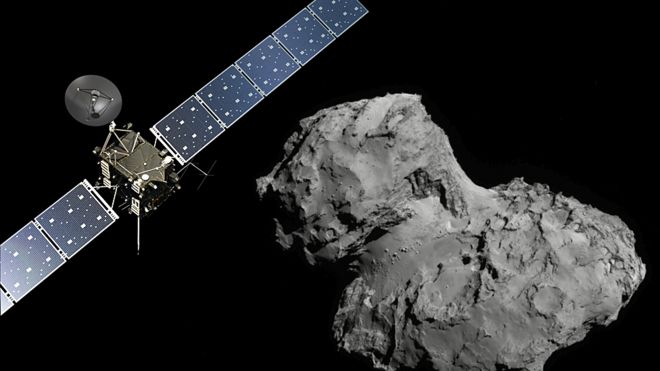
RosettaThe Rosetta spacecraft arrived at the comet in August 2014


The Rosetta test will be accident arrived on Comet 67P on Friday 30 September, the European Space Agency has affirmed. 

The move, which is relied upon to decimate the satellite, will convey to an end two years of examinations at the far reaching cold slime bucket. 

Flight controllers plan to have the cameras taking and handing-off pictures amid the last plunge. 

Sensors that "sniff" the substance environment will likewise be exchanged on. 

Every single other instrument will be off. 

Flight flow specialists have still to work out the fine subtle elements, yet Rosetta will be put into a tight circle around the comet and directed to drop its periapsis (most reduced pass) continuously until it hits the duck-formed item. 

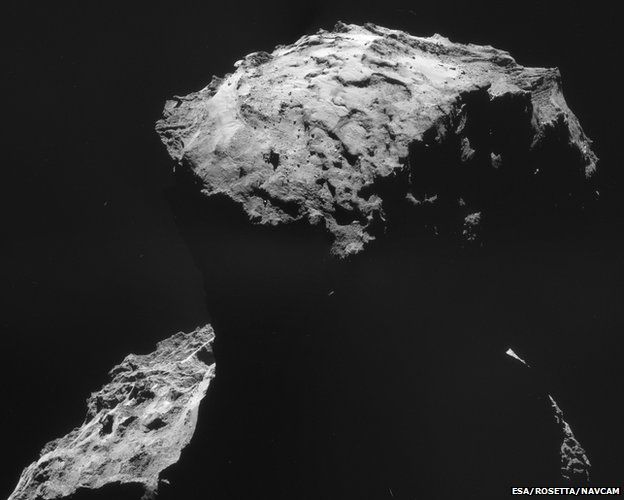
Mission administrators have already discussed getting it down a spot named "Agilkia" - the area initially handled its surface robot, Philae, in November 2014. 

In the occasion, Philae bobbed a kilometer away, however Agilkia's moderately level landscape is an alluring alternative still, albeit different targets are being concentrated on.

67P
Controllers may aim again for "Agilkia", which is on the "head" of the duck-shaped comet

Having cleared around the Sun last August, Comet 67P is right now on a direction that is removing it from the inward Solar System towards the circle of Jupiter.

Today, the test is almost a large portion of a billion km from the Sun.

This implies the measure of light falling on Rosetta's sun based boards is steadily lessening; and, as an outcome, it has less power step by step to run its instruments and sub-frameworks.

Designers would soon need to put the satellite into hibernation mode on the off chance that they needed to utilize it long haul - amid 67P's next experience with the Sun in a couple of years' opportunity.

Be that as it may, having effectively put in 12 years in space, fighting tremendous temperature swings and harming radiation, also an abundantly lessened fuel load - there is little certainty Rosetta will at present be operable so far into what's to come.

The accident arrival then again offers the chance to get some nearby in science to supplement the more far off remote detecting it has been doing.

Controllers will attempt to keep up contact with the satellite for whatever length of time that conceivable amid the last plunge.

Much will rely on upon how well Rosetta adapts to the dusty environment around the comet.

Late months have seen a few events when the test's route hardware, which tracks the stars to characterize a position in space, has befuddled in the whirlwind of particles exuding from 67P's surface.

This has stumbled the satellite into a "protected mode" that close down all unimportant operations, including instrument perceptions.

Rosetta should be instructed not to do this in the prior minutes sway.

Crash-landing has turned into a typical approach to end the missions of planetary tests.

Most have been high-speed sways, however a couple, similar to the one Rosetta will endeavor, have been strolling pace touchdowns.

The US space office's Near Shoemaker test put down on the space rock Eros so tenderly that it kept on working for a further two weeks at the surface before architects in the long run resolved to end interchanges.

This is unrealistic to be the situation with Rosetta, be that as it may. Controllers are relied upon to program an auto shutoff, which will be activated right now the satellite hits 67P.

Regardless of the possibility that by chance its radio wire were to survive the pulverize, it won't call home.